They're Blaming Your Body, Not Your Job. It's the Oldest Trick They Have.
"Pre-existing condition" is how insurers deny real work injuries. Here's the part they leave out — and why a prior condition often doesn't sink your claim at all.

You got hurt at work. You know exactly when it happened. And then the denial letter came back with a phrase that made your blood boil: pre-existing condition. Translation: they're not saying you're not hurt. They're saying your job didn't do it — your age did, your old injury did, your "bad back" did. Anything but them having to pay.
Here's what you need to know before you accept that as the final word: blaming your body instead of your job is the single most common way insurers deny legitimate work injuries. It's not a medical finding. It's a strategy — and in most states, it's a beatable one.
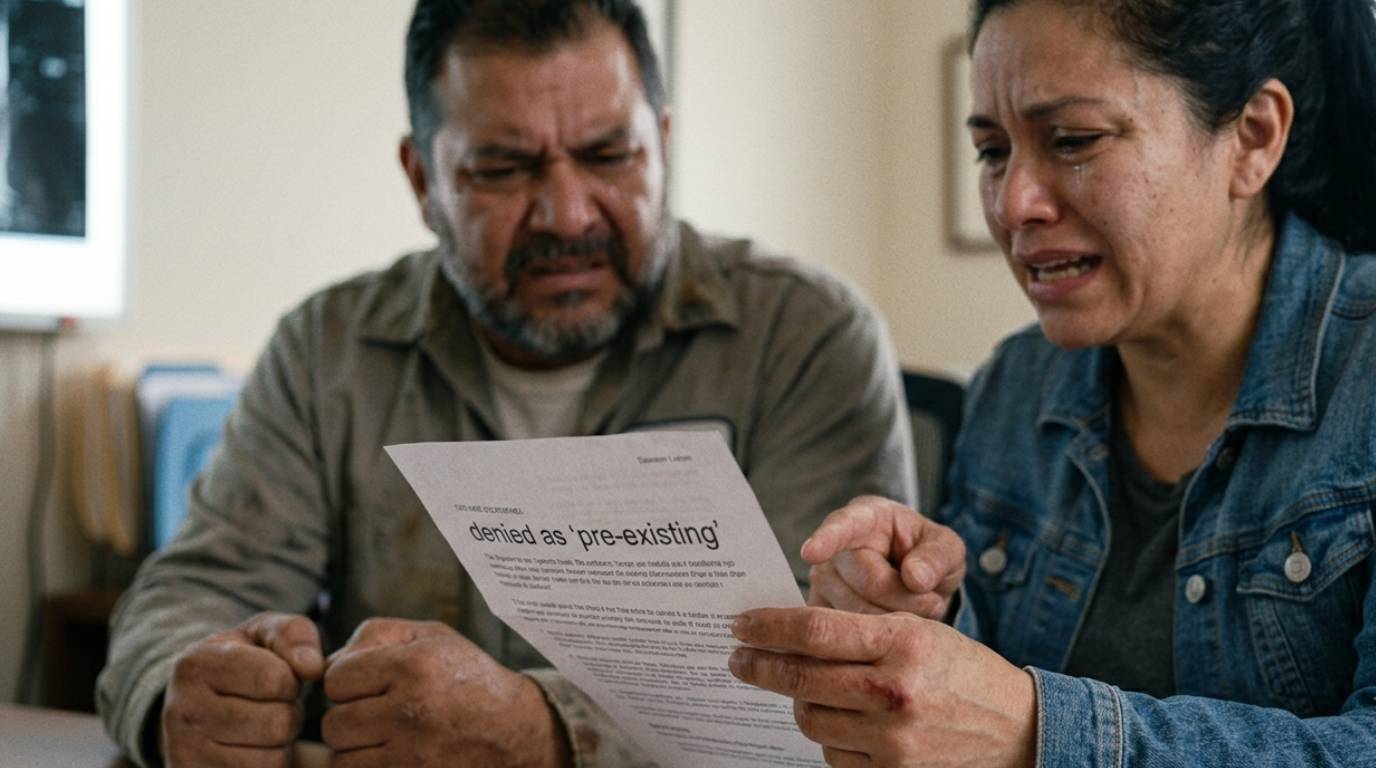
Why "pre-existing" is the insurer's favorite word
Because it works on almost everyone. By the time you're in your 30s, 40s, or 50s, a scan of your back, knee, or shoulder will show something — a worn disc, some arthritis, an old strain. That's not a defect. That's being a human who has lived and worked. But an insurer's exam doctor can point to that normal wear and say, "See? This was already there. Work didn't cause it."
They're weaponizing normal aging to avoid a payout. And they're betting that the word "pre-existing" sounds final enough that you won't fight it.
Denied for a "pre-existing condition"? Find out if your claim can still be won.
Answer a few quick questions — it takes about 60 seconds.
Check My Denied ClaimFREE · PRIVATE · NO OBLIGATION Prefer to talk? Call (858) 727-0373
The part they leave out: aggravation counts
Here's the fact that flips these denials, and the one insurers hope you never learn: in most states, you don't have to have been perfectly healthy for a work injury to be covered. If your job aggravated, accelerated, or worsened a condition you already had, that's generally still a compensable claim.
So the disc that was "a little worn" and then blew out when you lifted a load at work? The knee that was "arthritic" and then gave out on the job? The insurer wants that to be the end of your claim. In most states, the law says the opposite: if work made it worse, work is on the hook for making it worse.

Consider the source of that "pre-existing" label
The "pre-existing condition" finding almost never comes from your own doctor. It comes from an exam the insurer arranged and paid for — often a brief once-over by a physician who sees you once and writes the report the insurer needs. That's the "evidence" being used to deny you.
Which means the fight is usually one medical opinion against another: your treating doctor, who knows your injury, versus their exam doctor, who was hired to find a reason to say no. That's a winnable fight — but it's the exact matchup that goes badly for workers who walk into it alone.

What to do now
If your claim was denied as a "pre-existing condition," don't take that word as the verdict the insurer wants it to be. The right medical opinion — connecting how work aggravated your condition, filed before your appeal deadline — is what overturns these. Find out whether yours can be challenged. It's free to check, and in workers' comp, attorneys typically don't get paid unless you win.*
Why injured workers use Work Injury Claim Center
- 100% free — it costs nothing to have your denial reviewed
- You pay nothing unless you win
- We connect you with a workers' comp attorney in your state
- Built to fight denials, cut-offs, and lowball offers
- Private, with no obligation
Work Injury Claim Center is a free attorney-matching service — not a government agency or law firm. We connect injured workers with independent attorneys licensed in their state. This is attorney advertising. Submitting a request does not create an attorney-client relationship, and no result is guaranteed. Past results do not guarantee a similar outcome. *Statements about outcomes with representation are general and not a prediction about any individual claim.